National Social Action Week: PROPEJA in Arta, 54 Beneficiaries Selected for Project Funding
15 January 2018• Actualté
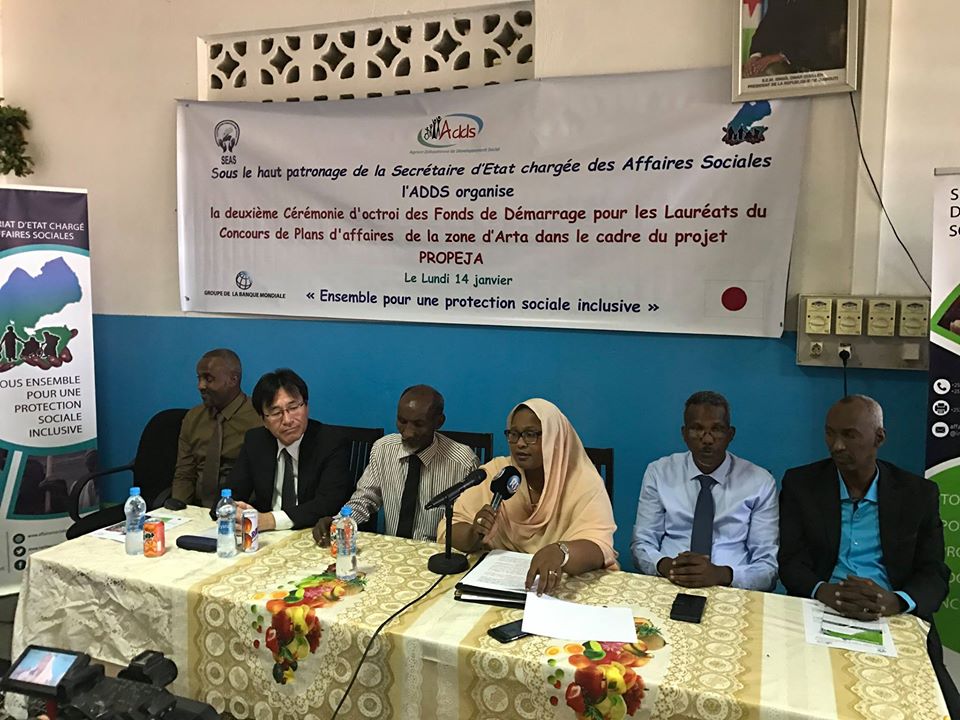
As part of the week dedicated to social action, the Secretary of State for Social Affairs, Mouna Osman Aden, sponsored a ceremony yesterday in Weah, in the Arta region, organized by the Djiboutian Social Development Agency (ADDS) to honor the second-cycle winners of the Propeja competition.
As a result, 54 beneficiaries were selected following a contest to receive funding of 400,000 DJF each for their respective projects.
The ceremony took place in the presence of the ADDS Social Development Director, Dirieh Farah Souldan; the Advisor to the Embassy of Japan in Djibouti, Takanari Kakuda; the Prefect of the Arta region, Abdillahi Darar Okieh; the President of the Regional Council, Elmi Bouh Goudadeh; the Member of Parliament for the Arta region, Omar Waberi Malow; and the Propeja Project Manager, Ide Mohamed Abdillahi.
Carried out with the support of the Japan Social Development Fund and administered by the World Bank, the Youth Employment and Handicrafts Promotion Project aims primarily to improve access for youth and women to income- and job-generating opportunities through training, guidance, and funding for their income-generating activities.
The project provides basic entrepreneurship training, a micro-project competition, and support for female artisans ranging from production to marketing.
For the ADDS, the goal is to implement a poverty reduction strategy and facilitate access to funding for at least 3,000 low- or medium-skilled young men and women from the communities of Djibouti City, Arta, Tadjourah, and Ali-Sabieh.
Indeed, under the leadership of the Secretariat of State for Social Affairs and in partnership with other sector ministries, the ADDS implements programs, projects, and sub-projects aimed at improving access to basic social services, particularly healthcare, education, drinking water, youth support, and sanitation.
In summary, the ADDS seeks specifically to facilitate access for vulnerable populations to financing sources and micro-enterprises, while encouraging beneficiary participation in the design and management process of ongoing programs and projects.